When astronaut William Anders looked out from lunar orbit in 1968 he saw an extraordinary sight: the planet Earth rising above the horizon of the moon surface,much as the moon itself does from Earth's point of view. He took several photographs. One of them became extremely famous and become known as Earth Rise. Its now an iconic image seen on everything from postage stamps to posters. It was also massively influential culturally. The baby boom generation-poising themselves to challenge authority and change the world, took a look at this small and fragile image and a massive change in ego orientation occurred They began to realize that the eco system of the planet was equal if not more important than their own individual lives-especially considering all human beings live on Earth. Two years later, this culminated in the celebration of the first annual Earth Day. This is one of the reasons why I have and will always continue to challenge all those people who question the value of space exploration,there argument being that we have too many Earthly difficulties to fix than to spend money sending humans to explore outer space. When the very first astronomers began to realize the nature of the solar system, human beings generally believed the Earth was flat and would fear that sailing ships too far out at sea would consequently sail off the end of the world. Sometime later another astronomer named Galileo altered human perception yet again so people realize the Earth was not the center of the known universe but rather orbited a stellar body. Even though a lot of society is still bound by different creation myths about the origins of the universe, people are all the better for understanding and being able to see their universe as they do today. If one takes a moment out of their all too fast and busy modern lives, it really isn't even a great revelation that our exploration of the cosmos-whether it be by a homemade telescope in 1590 or an orbiting space shuttle in 1985, in inexplicably tied to our understanding and appreciation of our own planet. The majority of people I talk to are convinced that more people should be taking greater responsibility for what happens to the planet Earth. In the same quarters,however paranoid thoughts about the realities of climate changes and even watching someone casually tossing a garbage bag from a car window onto the side of the road may produce a great deal of cynicism and hopelessness about human being's abilities to effectively take care of our natural environment. Its a disturbingly strong sociological division between people to be able to produce all that effective a solution so it seems. It would take a great deal of time to fully explain how this could work. But I personally envision a simple and cost effective way in which humanity could still enjoy all the technological fruits of today while living in complete harmony with their natural environment In basic terms, it was to do with ones effort and interest. As much as I've done this I'll quote Dr.Helen Caldicott regarding her thoughts on this issue. If all people (male and female) harnessed the same instincts they'd have to protect their children from harm towards the protection of the Earth's natural resources, its likely they would find that said environment would gradually improve itself by the virtue of their now wholehearted efforts. Many words of this sort have been spoken,many of them not heeded. I don't necessarily expect my own words on this to be any different. But to sum it up, the more opportunities we have to see the planet we live on from a distance, the more we will value and wish to protect it from harm.
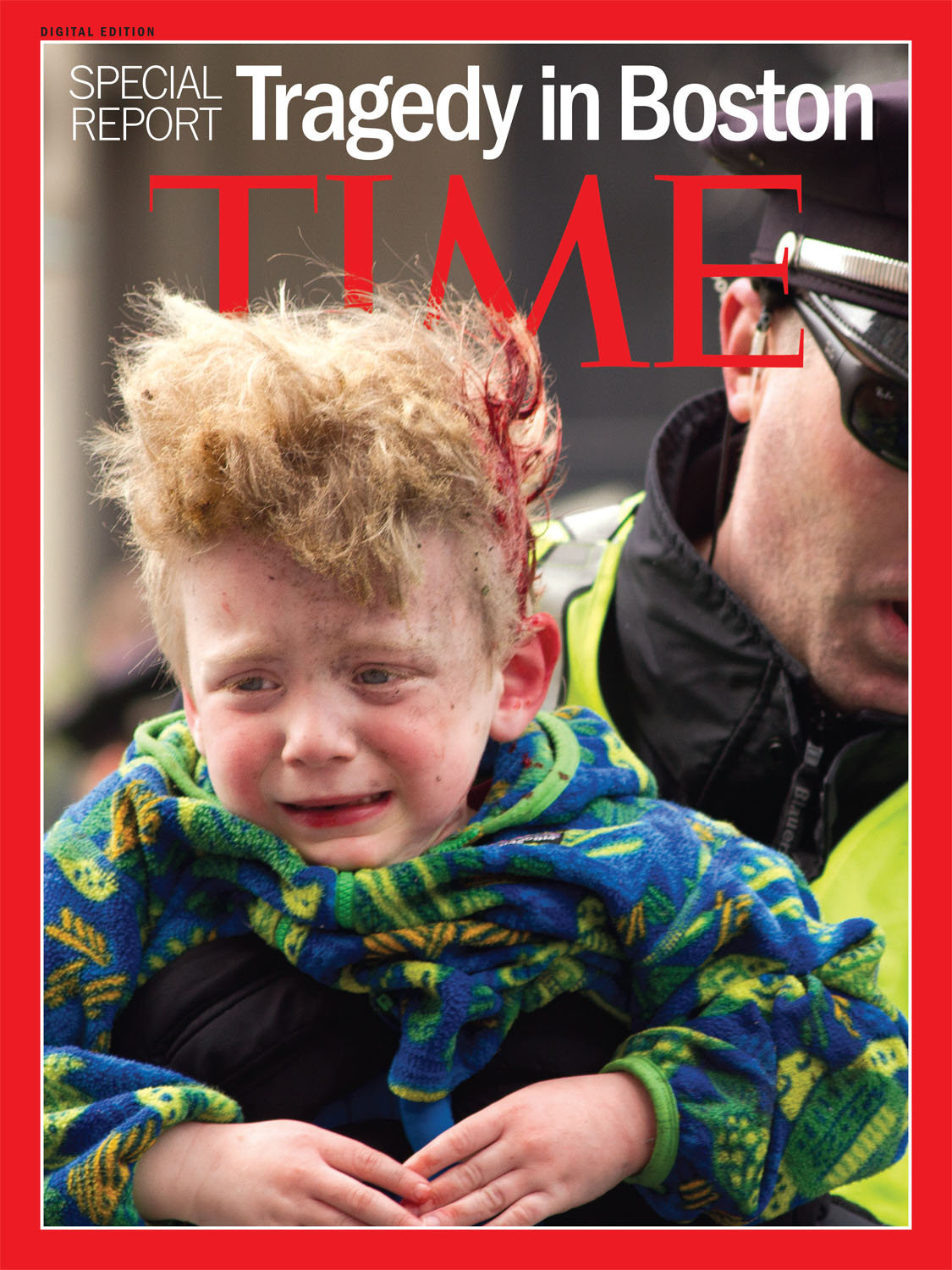
A controversial image appeared on the cover of Time magazine this week. This injured child with blood soaking his hair was one of the many wounded individuals who were present at the finish line of the Boston Marathon on Monday morning. Two shrapnel filled bombs exploded there-killing three people all under the age of 30 and injuring at least 170 others. Four days later the investigation is only beginning to round of suspects. And already many rumors have began to spread. Two things are certain however. Many of the participants in the Marathon were raising money for Sandy Hook victims. And today members of the US senate voted against a proposed bill to increase back round checks on anyone purchasing fire arms. Personally its difficult for me not to see a connection between all of these things. I have never been one to go with my generations zeitgeist for conspiracy theories and obsessions with opposite types of legends. And that has not changed. From the Colorado movie theater and Sandy Hook shootings last year to this incident at the Boston Marathon earlier this week there are signs that many Americans have became desperate, angry and even violent. Members of the inherently homophobic Westboro Baptist Church have already publicly announced that they place the entire blame for this tragedy in Boston on same sex marriage rights. We have a president who is doing all he can to try to get other politicians who have become psychically numb to fighting, killing and injustice to look for reasonable solutions to the social problems we've all denied. This being such a wonderful concept, why would anyone fear such positive progress? The theory that I personally tend to agree with is that too many people have decided to fight against human nature. Over and over again, we've seen human nature evolve. Each generation, each moment of every day is a new learning experience many of us are perhaps not fully aware of. Yet between the creation mythology religion provides and our own emotional stubbornness, many people resist personal evolution. There was a period when I was growing up when there was an enormous sociological trend towards the philosophy that human beings were inherently predators-born to fight, hunt and kill for territory and food. And that no civilized society could totally amend these instincts. This resulted in unremittingly fatalistic and self destructive behavior. And these behavior patterns are firmly established in the hearts and minds of the young generation poised to run America in the next half century or so. Good sense in ones thinking would say that back round checks on new gun owners would be a win/win situation. There would be less gun violence, and the mentally unstable would not have as easy an access to deadly weapons. However that element that resists personal evolution, those who are motivated mainly by fear and economy, seem intent on convincing the more enlightened individuals around them to without progress just to temporarily make them personally more comfortable. Its been a focal point in every single one of these tragedies created by human hands for as long as I can remember anyway. It seems appropriate that soon as human beings realize that a society based on inherent non violence might be their most physically and emotionally productive future, we'll have more time for living and less time for dying.
Growing up in a suburban/semi rural community as I did, one of the first things that I was asked when meeting other children my age was did I have any brothers or sisters. Never thought about it at all before hand. When I asked my mother and father why that it was that I had no brothers and sisters, they said that it was because I was an only child and that they weren't interested in having anymore children. That was an extremely satisfying explanation. When I did get harassed and bullied during my school years it was never for that particular reason. All the same, this would not be the last time that I would have to face the music in terms of being the only child in my own family. My mother had two surviving half siblings. My father and his mother, on the other hand, had both been only children. As I grew older I began to hear them told by child psychologists and other adults, none of whom indicated they themselves were only children, that people who grew up without brothers and sisters would never have healthy social interactions with other. These were discussions I was not meant to hear. But I did, as most children tend to. Sometimes they made me sad to hear them. After a time, however I just became quiet about it. Until I was 11-12 years old that is. And it was time to make it clear that I, and others like me were misunderstood people. In many different ways its the root of many of the struggles I've endured with people most of my life. After all these years, the time seems right for me to set the record straight on how I feel about how much of society views only children. As this two year old Time magazine cover shown above illustrates, the concept of the only child in the world is completely misunderstood. True there are economic factors in society that contribute to the acceptance of only children. However related political thinking results in only children's many detractors in the past. That opinion basically stated that an only child would eternally see themselves as the center of the universe and have trouble sharing. My own eyes paint a different picture however. The ability to share and be kind has more to do with cognitive parenting than siblings. When I came home from school or a friends house growing up, I could count on at least one parent always being home. I belong to the generation of the latch key kid. Most other children I knew were latch key kids. And they often had several siblings. Mostly younger than them. And between holding down jobs and attending to the other siblings, these peers I knew didn't often have anyone to go home to. And it had an effect on their behavior very strongly. Some older than me might've thought I was self centered automatically. Some of that was because they seldom took the time to know anything about me. In fact it was clear that many of these latch key children had some of the worst behavioral qualities one could ever find. Even ones observable to a preteen such as myself. Many of them became hardened bullies of the most frightening kind-even to the point where no authority figure in a school was able to discipline them effectively. All that an alleged "spoiled,arrogant and socially awkward" only child such as myself could do was operate as the community eccentric. And to a degree I did. Because most of the social structure of youth is based on social status and being part of a team. Probably didn't help I showed no interest, and often open disdain even then, for organized athletics. To this very day, I still feel very much like that desirous and somewhat insecure 19-20 year old. The person who has vital knowledge that could benefit others greatly, and could be a somewhat more productive participant in the dialog's talking place around them if given the chance. I am no longer convinced its only children who are the only ones considered truly hopeless. Its children in general. It seems today ignorance is expected of young people so, they consequently behave accordingly. People tend to believe that discipline, usually of the physical sort, is a solution to the problem. Being at the age where I could now theoretically have a preteen child myself, I now see the solution is parenting: a relationship between family and their children (or child) based on mutual trust. And even an only child who feels trust will very likely have a heart of goodness his entire life.
During another of a series of fascinating conversations with my friend Henrique in Oakland,California the topic of style came up. Not style in the mass media context. But rather in terms of individual taste. It was bought out, and quite truthfully, that the shared fascination within the 60's counterculture and hip-hop based fashion community of dressing down and generally not caring how they appeared rendered that particular manner of attire no longer a fashion statement-as so many were now following this as a trend. In fact the real moniker of "rebel cred" during the 90's onward actually came from dressing more formerly, such as in a suit jacket and a pressed hairstyle, or simply wearing clean and coordinated attire. The key word to this type of ethic would be the appreciation of dignity.
In its pure form,dignity is perhaps one of the most unknowable forces in the lexicon of the human race. Dignity is something you can't create,buy or sell. Its either a part of your nature or it isn't. Most people actually stand in between those two ends of the yardstick. Upbringing,specifically back round and economic level play strongly into a sense of at least subjective dignity. And that basically means a lot of people define dignity by how they appear physically. While this can lead to a good deal of narcissism if uncontrolled, dignity can be an accurate indicator outwardly if said person is fully in control of how they project their fashion sensibility. I am now going to discuss two public examples of this. Two examples who are culturally a lot closer aesthetically than one might think: George Clinton and Barack Obama. During the 1970's, George Clinton was the mastermind of the entire P-Funk musical cooperate with several different bands operating under his banner and carefully in control of his highly conceptualized extra-terrestrial theatrical image. During the 90's however, his commercial fortunes plummeted due to years of poor business practices and substance abuse problems, he had begun to appear at alternative rock festivals wearing Lion King sheets and multi-colored shoe laces in his hair. In more recent years,however Clinton has developed a higher musical profile. As he has become more seriously iconic, his image has adopted a more stylized approach with a pressed suit,tie,hat and gold rings signifying the more dignified nature of his current notoriety. Barack Obama's experience with dignity is rather different. On many levels, from his cultural back round to his campaigning methods, he is an historic president. One of his physical trademarks has been holding his head very much on high while addressing the nation in his speeches. Many of his admirers such as myself view this trait as very much in keeping with the attitudes of the great activists/civil rights advocates of the past few generations. Others, most of whom claim not to be his detractors, see this as Obama looking down on those he speaks to-more in the manner of a king or a royal figure than a president of a democratic nation. And further more that this gestural manner on his part should be reformed as for Obama to better relate to the American people. In particular I imagine younger American people. All of this brings to mind one of the key factors about dignity in the modern world: generationalism. George Clinton was part of what writer William Strauss called the "silent" generation-those who became trendsetters and whose carefully controlled egos inspired the sociopolitical and sexual revolutions of the 60's and 70's. Barack Obama is on the older end of Generation X. This is a generation I am on the youngest possible end of. And by and large its a generation that values humility over dignity, one that would rather be "down with the people"-who'd prefer to follow trends rather than set them. As for myself there's a balance of this in terms of fashionable aesthetic. I am generally a casual and yes, even humble dresser and enjoy bright colors. However nine times out of ten, I'll tend to want to carry this all as well as possible. As Stevie Wonder sang in his song "Living For The City",your clothes can be old but never be dirty. Of course dignity reaches considerably beyond the outward expressions of ones manner of dress,hairstyle or even the gait of their walk. To quote another musician,in this case the artist then formerly known as Prince, style is a second cousin to class. And class is actually a shorthand term for dignity itself. Most people realize inwardly that humility and dignity are not disparate concepts-that they work very much hand and hand. But most people view ego only through the filter of "ugly ego" such as snobbery or even megalomania. An ego that's directed outwardly, one who flaunts their fashion sense,through clothing or physical gestures, as an important social statement or even an activist who makes sacrifices in commerce to help others. That level of expression is the real art of ones dress and the most genuine side of the style of dignity.
Over the stretch of time its become clear that in order for the human race to become more at peace with themselves, its appropriate to be able to talk well as much as we would listen well. Especially among various Native American cultures and Buddhists, one's ability to listen far outweighs ones ability to speak. Still human beings have the physical senses to do both equally well. Because Western society has become somewhat overwhelming in its breadth and scope, that value of "silence being golden" has devalued the valuable concept of speech somewhat. This is a vast and difficult subject to explore. So with the risk of being egoist I will use examples from my own life to illustrate different points on this particular subject. During my school years the main quality that was negatively attributed to me by both family and teachers alike was how much I talked. Now I had a constant stream of consciousness that seemed to find its way to my mouth faster than others could hear it. Since this was my natural way of communicating, I found it difficult to understand why so many people objected to it. And that did, and actually still does, make me quite irritated at times. When I slow down my speaking voice and leave enormous space between thoughts, the things I say are better appreciated but conversing with others this way is mentally and even physically uncomfortable for me to do. This comes to the fore during different events in my life as well. Last weekend I visited a store called Portland Trading Co. in the city of Portland,Maine. It was a wonderfully homey environment that sold semi formal dress wear,post cards and had a very personalized, historically fascinating decor. The man who started this business's name was Kazeem. I related instantly to his own stream of conscious manner of speaking. Having a fascinating Nigerian/American heritage, I was captivated by his intuitive cultural understanding of himself and others. He had a very independent mind. I learned I could listen to others who had much to say as well as I could be on the other end of such a conversation. Yet I also understand based on my own history how that mode of speech is not universally relatable. One of the important points Kazeem made which I will use to refer to my own point on human conversation is the importance of empathy. One thing I've noticed in this more careerist world is that many people are now convinced that the only way to change the world for the better is to mainly concentrating on changing ones self. This naturally leads to a hectic lifestyle in which a strong level of conversing becomes too difficult and time consuming for said person to handle. For a person such as myself whose lifestyle is rather individual, it makes it all the more complicated to communicate the points that I do have. This has a habit of leading to problems in basic tolerance and can in fact result in heated conversations with less understanding individuals. Another area where this lack of conversational empathy comes into play is on the romantic level. Naturally the very concept of a romantic affiliation between any two human beings at its core requires a deep level of empathetic thought. When the only emotions one vocally espouses have to do with their own self, its sometimes next to impossible to create a balanced level of emotional understanding. In such cases, I feel its very appropriate to speak a great deal to such a person. To show your passion, commitment, intellect and willingness to advance as loving companions. Friendship functions on much the same level. If one has ears to hear, they also should understand the importance of using their voice to speak. It has,still does and might always make me feel personally discouraged when I am told by others that my conversational skills are objectionable. Yet after years of learning-sometimes the hard way, about human socialization I inwardly value my stream of conscientious conversation. I'd even go as far as saying its something many people could actually learn from if they gave me more of a chance. In a strange way, its actually helped me to listen to others better by understanding how to relate to other different methods of conversing as they do to my own. The key with conversation is to learn as much as you can from it: how to speak, when to speak, when to listen and remember always to mutually benefit from the experience. The more people understand this truth, and each other the more contented and settled I feel we'd all be.
So much goes into an individual such as myself trying to generalize about the entire sociological structure of a particular decade. A good example of the difficulties involved in doing such a thing would be when I decided to discuss the decade of the 1990's. Physically speaking this decade has been over for fourteen years now. As with any period of time one can imagine, it had its trials and errors. The most interesting part of the 1990's, looking back on it well over a decade after the fact is how it laid the groundwork (for better or worse) for the culture we have today. In fact its still very much a part of my personal life too. I was never the same after the 1990's. And in all honesty I am still recovering from the influence of its societal maelstrom. The years 1990 and 1991 were by and large a time that was filled with much hope for the future. Star Trek The Next Generation and I'll Fly Away were on television-giving a sense of hope for the future and historical closure on a dark chapter of the fast. Operation Desert Storm came to a close and the troops began coming home. The better qualities of the 1980's looked to be resolving themselves in a new decade that, at first promised hope and above all a strong sense of futurism to society in terms of the culture at large and our technological development. An age of balance about healthy living, taking care of our natural environment and genuine respect and tolerance of other cultures was ascendant. Than at the end of 1991, as far as I was concerned,something went terribly wrong.
At the end of 1991 a new music video cropped up during my weekly viewing of Friday Night Videos. I had my naturally curly hair about shoulder length and was probably wearing faded jeans and a neon colored t-shirt. This video came on by a band called Nirvana. The music was so loud and the melody so frightening I backed away from the TV screen-watching images of this pep squad cheering in this frightening,muddy colored mess. This unwashed looking guitar player, who I later learned was named Kurt Cobain, sang almost unintelligibly until screaming out "HERE WE ARE NOW,ENTERTAIN US!". I remember going in the kitchen for a snack waiting to see my favorite video at that time which was "Do The Bart Man". I figured this horrifying video was a fluke and life would go on. It was not quite to be in fact. That following autumn of 1992 after what had basically been a good rest of 1991 I began middle school. The first day I arrived there most of the children looked like that dirty man in Nirvana's video I'd seen. And many acted just as mean and aggressive as well. I was being bullied relentlessly-now for wearing the "wrong clothing". I heard it said recently the 90's were like the 60's upside down, and I cannot disagree. Instead of clothing defining a person,it could now make or break them. I had a profound revelation about how life was doing to be after this horrendous experience. And how many 12 year old's are even supposed to have anything at all profound on their minds? Somehow though, it was now clear that I was going to come of age in an era that culturally rejected poetry and embraced realism. In the 1970's and 80's music was often a motivating factor in enacting social change. By the mid 1980s Bob Geldof, Stevie Wonder, Michael Jackson, Sting and bands such as U2 were all directing their musical messages towards humanistic concerns-from farmers rights to homelessness. By 1993 and 1994, the majority of the songs that seemed to direct the public consciousness had a more to do with violence-either by aggressively harming another or flat out suicide. The most popular musical styles of the day-grunge rock and gangsta rap captured that spirit. While anything that sounded joyous and spirited seemed to be a source only for laughter.Much of this culture I call now "alternative culture". They were often famous for a wholesale rejection of anything from the previous decade,often with hostile vitriol. 1980's cultural icons such as Pee Wee Herman and Michael Jackson-who represented humor and kindness, were made into public scandals during this time. While Courtney Love and Shuge Knight, who basically represented avarice and organized criminal behavior, were elevated to the role of pop culture icons. The focus the public had on the news media also shifted accordingly. Legitimate news programs became secondary sources for vital information to the supermarket tabloid,as well as their televised equivalents such as Hard Copy and Inside Edition. This in turn led to the development of many superstitious conspiracy theories and revisionist history that captured the attention of people of all ages. People's humor and basic language was becoming more cynical and nihilistic. One of the major cultural factors of this era was its tendency to confuse expressiveness with pretentiousness. In fact "pretentiousness" suddenly become something of a buzz word to describe most any music,film or work of literature that celebrated the poetically emotive creative ethic. This was a time when those children born to the baby boomers,known as the 13th or "Generation X" later on, were in adolescence or adulthood. Those born during the 1960's were the young celebrities of this era. Including those like Kurt Cobain and Courtney Love. They resented their parents for what they saw as a failed attempt to create a bohemian utopia, and saw them as selling out. They turned inward and became largely more self concerned, with an extremely corporate sense of thinking as a thin veil to a layer of arrogance. Personally I had many positive experiences in the 1990's. Visited some new places and new some often good and interesting people as acquaintances and sometimes friends. But it was a decade I still celebrate being over to this day because I found much of it culturally unendurable. Even to this day those who call the 1990's their generation still often flatly refuse to admit the flaws that defined every aspect of popular culture and the psychology of that era. If one reads all of the above objectively, and looks at what they see wrong in the world around them most of its seeds were planted not in fact in the 1980's-as of course the 1990's zeitgeist falsely championed throughout the decade. But these seeds of disillusion that often defines the post 9/11 world were in fact planted in that decade where the 60's were in fact turned upside down on its head.
When I was eight years old I watched an European released animated special on a program called Long Ago And Far Away-hosted by the late, great James Earl Jones. The special itself was called Bill And Bunny. It was about autism. And how a child who had it effected her mother, father and older sibling. It was a topic that at that time had not really been discussed in depth before. And I'd personally never been exposed to it. It was told in a beautifully poetic manner that appealed both to children and their parents. A rare feet. Two decades later I looked up, and it seems about one in every ten children or more are living with some form of autism. As I've stated in my YouTube videos many times, even people who aren't diagnosed with autism are referred to as having an autistic manner. It's extremely puzzling to me how autism has become such a modern legacy of society. It is not lost on me why one of the symbols of autism awareness is the four multi-colored puzzle pieces. Autism constantly reveals itself as a mystery wrapped in an enigma. Those who live with it often show genius level intuition and intelligence. On the other hand what should be a simple social situation might drive them into a state of panic defined by repetitious behaviors. These individuals seem, on the surface to live in a world of their own. I know this because one of my cousins lives with autism. And I have myself witnessed his outlook on life. April is Autism Awareness Month. It is also Poetry Awareness Month. I was not aware of the latter until yesterday in fact. And the more I thought about it, a rather profound truth revealed itself in my mind. That truth is that autism and the concept of poetry are actually very complimentary.
One of the qualities I've personally observed in society as I matured was something of a rejection of abstract thinking. You could look at it much the same way as when in the late 1920's when silent films transitioned into "talkies": the medium of motion pictures become less of a poetic one and more of a realistic one. The television show Star Trek: Deep Space Nine summed it up in a show called If Wishes Were Horses: that so many people dream of places they'll never go, things they'll never see instead of paying adequate attention to their real lives. Since this particular concept has continued to evolve itself, I feel it has in turn de-evolved an element of society. If one doesn't take their hopes and dreams seriously any longer, than the realistic medium of commerce becomes the driving force and a given civilization will tend to become soulless on many levels. I've noticed this very situation occurring in every segment of life. Adjective words such as "geek" and "hysteria" are constantly used in a cold and improper context with no real care to their true meaning and original degrading intent. So if so many people have actually forgotten what respect means, than it's nearly impossible for have respect for what's happened to people around you-such as those living with Autism. That term in itself is sometimes even used, as I mentioned earlier as a pejorative term in much as the same manner as "retarded" was decades earlier. Still the technology of science,from the internet to micro circuitry has also steadily evolved with the advent of the computer age. Since the human soul in general has tended to be more and more deprived of imagination and poetry in the past fifteen years or so, there hasn't been enough agreement and focus on what the exact causes of autism are and how to deal with it physically. Especially since all too many researches have pursued the study of autism primarily to gain profit and recognition. During my elementary school years, the study of poetry was not among my favorite topics. I felt in my pre-teen years that studying the forms of poetry too much spoiled the poem. Trying to explain poetry seemed totally self defeating as the medium was more about feeling and expression-that it was equally about what was said as much as how one said it. As I got older and began to learn about the lives and experiences of poets such as Samuel Taylor Coleridge, Nikki Geovanni and Alan Ginsberg the meaning and intent behind their work in fact revealed itself to me in a similar manner to how the subject of this very article did, actually. One thing that's become clear with time is that while autistic individuals have a very unique way of learning, they are more than capable of learning. Even though I am not autistic, my own more 1960's era abstractly creative mind also processes knowledge and information in a somewhat different way than expected by most other people as well. When you boil it all down the real issue of the public's attitude towards both autism and poetry is an appreciation for that which is unique and unknown. I was at a local record store a year or so ago called Bullmoose and I saw an autistic man who my family and I had known for some time. He was listening to headphones on the listening station. Most of my life I'd been told autistic people had mechanical thought processes and had little to know ability to abstract or be at all clever. I never took that to heart for one moment, and on that day at Bullmoose my own theory was confirmed. This man was dancing and singing to himself to the music he heard on the headphones-in his own world definitely but just as surely a world that was defined by an embrace of creative thinking. He was clearly moved by the music on a deep emotional level perhaps beyond even my high level of emotionalism. That confirmed my own personal theory: people who live with autism are highly poetic. Perhaps more poetic and creative than some other people. And that is something to be truly appreciated.